Maduro makes second appearance at New York courthouse
Venezuelan President Nicolas Maduro made his second appearance in a New York court after his forcible seizure by US troops in a military raid in Caracas in early January.
US Navy Growler jets used electronic warfare to disable Venezuela’s air defences, allowing a swift operation that led to Nicolas Maduro’s capture, analysts and reports say.




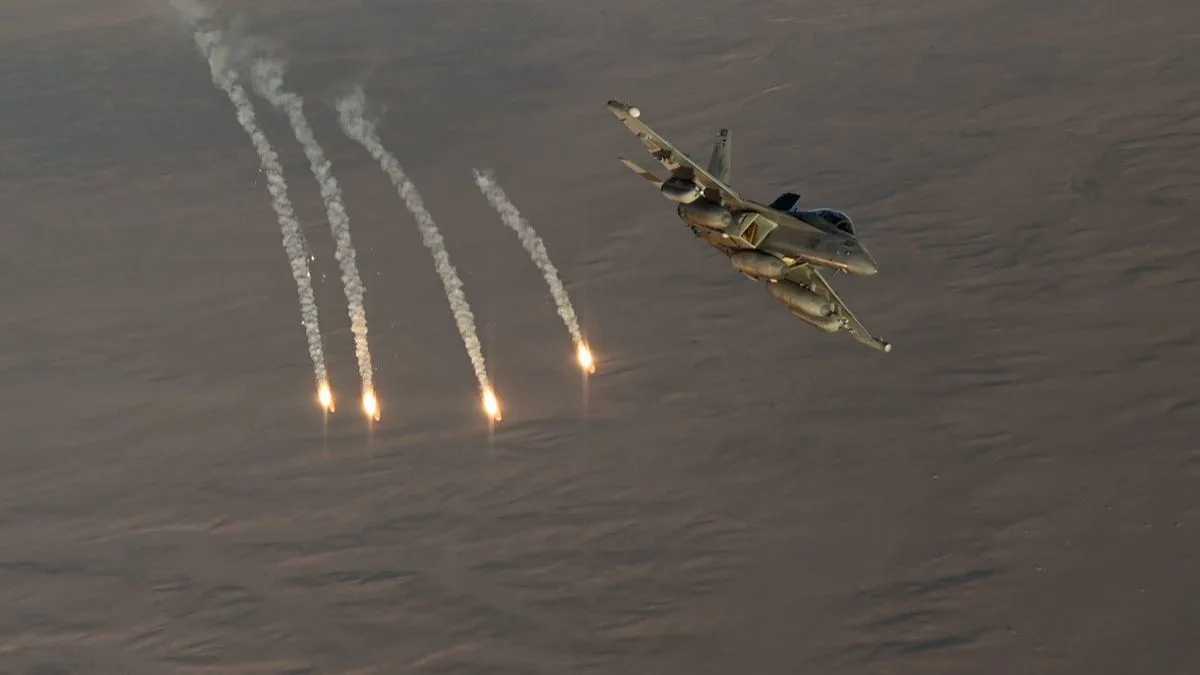
A US Navy EA-18G Growler aircraft releases countermeasures during a mission. (Photo: X/@CENTCOM)
US Navy electronic-warfare aircraft, known as EA-18G Growlers, were central to disabling Venezuela’s air-defence network during the military operation that resulted in the capture of Nicolas Maduro, according to a media report.
The operation leaned heavily on signal-jamming rather than firepower. That choice, a report in The Wall Street Journal says, reflects Washington’s renewed focus on electronic warfare in modern conflict.
Advertisement
Also Read: Implications of Maduro’s extraction
Advertisement
The Growler is built to control the electromagnetic spectrum. It does not drop bombs. Instead, it targets radars and communications. During the Venezuela mission, the aircraft joined a large US air armada that shut down radar coverage and jammed command links. This allowed special-forces aircraft to enter and leave Venezuelan airspace quickly, the report said.
Over 150 US aircraft took part, including bombers, fighters, and drones. However, the Growler stood apart. It attacked signals, not ground targets.
Electronic-warfare specialists explain why that matters. Jamming pods on the Growler detect enemy radar emissions, analyse them in real time, and respond with tailored interference.
Radar screens can fill with false targets. Real aircraft can disappear. This prevents surface-to-air missiles from locking on to incoming aircraft.
One Growler can protect an entire formation, turning it into what experts describe as a force multiplier.
The EA-18G is derived from Boeing’s F/A-18F Super Hornet and replaced the older EA-6B Prowler. It entered service in 2009 and is now the core of US airborne electronic warfare. It is also operated by Australia.
In Venezuela, the Growlers exploited weaknesses in an ageing air-defence network that relies largely on older Soviet- and Russian-made systems, including versions of the S-300 missile system, defence analysts cited in the report said.
Some Chinese radar systems are also in use, but most are older models.
Experts cautioned that such tactics would be harder against near-peer rivals such as China or Russia, which field more advanced and resilient defences. Still, the Venezuela operation highlighted how electronic warfare has regained importance after years of relative neglect.
In Afghanistan and the Middle East, US forces faced limited air-defence threats. That reduced the need for large-scale jamming. The war in Ukraine changed that calculation. It is now widely viewed as the largest electronic-warfare conflict in history.
Jamming technology is changing fast. The bulky, analog systems of the past, including the ALQ-99, are giving way to digital pods run by software. These can hop across frequencies in fractions of a second and adjust on the fly as threats emerge.
The new systems do more than block radar. They can break communications links or feed false information to enemy sensors, making it harder to tell what is real and what is not.
Even as rivals improve their own defences, analysts argue that airborne jamming remains indispensable. Future wars, particularly in the Indo-Pacific, are likely to be fought not just with aircraft and missiles, but over control of the electromagnetic spectrum.
As a former US defence official told The Wall Street Journal, electronic warfare may draw less attention than fighter jets or warships, but it is “critically important” in deciding who dominates the skies.
Advertisement